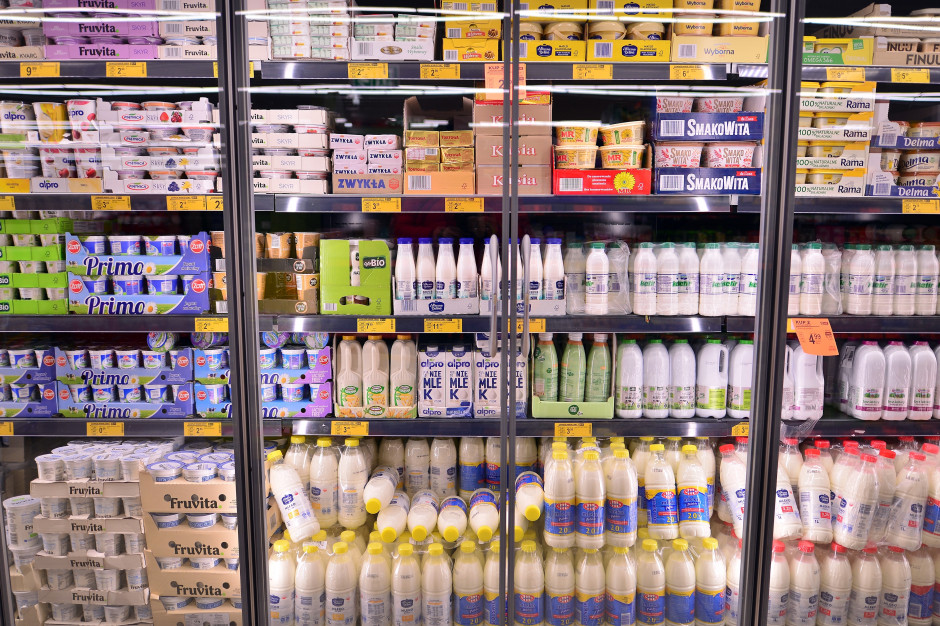
Customers of the Biedronka and Lidl chains in various cities in Poland have noticed a strange pattern: the same product can have a different composition depending on the sales region.
The issue was first reported by the author of the Facebook profile "Pomysłodawcy". As an example, he cited the 30% cream of Biedronka's own brand — Mleczna Dolina
According to him, in some regions the product contains only cream, while in others it additionally includes carrageenan and milk protein.
“Why is a product sold without additives in one part of Poland, while in another it’s a mixture with thickeners under the same name?” — the author questions.
He notes that carrageenan is a legal food stabilizer; however, its effects on the body are debated in the scientific community. In particular, there are concerns about its possible impact on gut microbiota.
The addition of milk protein, in the author's opinion, may also indicate lower quality of the raw materials
Użytkownicy mediów społecznościowych szybko potwierdzili to spostrzeżenie:
- “In Legionowo — sometimes with carrageenan, sometimes without, have to check every time”
- “In Białystok — pure cream, while in Augustów — already with additives”
As a result, a resident of Toruń receives a product with a thickener, while a resident of Częstochowa gets a "pure" one. Or vice versa. It all depends on the discount retailer's decision
Biedronka’s Position
A representative of the chain, Dr. Justyna Szymania, explained that carrageenan is a safe and EU-approved additive, widely used in creams for stabilization and ease of whipping
At the same time, the company is testing the clean label trend — products with the simplest possible composition
“We decided to offer cream without additives in some stores to test customer reactions”
According to her, the assortment is adapted to customer preferences. In fact, this means that in different regions the chain offers different versions of the same product.
What About Lidl?
Users note that similar differences exist in Lidl — but depending on the packaging
One customer reported that Pilos cream in a small package contains cream, milk protein, and carrageenan, while in a large package — only cream and carrageenan
Another example is cheese of the same brand:
- 300 g package: milk, salt, stabilizer, etc.
- 500 g package: already "pasteurized milk" instead of "milk"
The differences are minimal, but they exist — with the same product design
Lidl Polska's spokesperson, Aleksandra Robaszkiewicz, explained that the chain collaborates with different suppliers across the country, especially in the category of perishable products
“Maintaining a completely identical assortment is not always possible — this is related to technologies and differences in production.”
At the same time, the company emphasizes that it aims to maintain stable quality
What Does the Law Say
Since January 1, 2023, the Omnibus directive has been in effect in the EU, prohibiting the sale of identically labeled products with different compositions in different countries
However, within one country, the situation is less clear-cut
Experts note:
the product should not mislead the consumer — including regarding composition and properties.
Adwokat Robert Nogacki zwraca uwagę, że teoretycznie klient może zakwestionować sytuację, jeśli czuje się oszukany. Możliwe opcje to:
- complaint to UOKiK
- appeal to the Trade Inspection
- civil lawsuit
However, predicting the outcome of such a case is difficult
In this contentious issue, the Office for Competition and Consumer Protection (UOKiK) ultimately expressed its stance.
The government agency focused primarily on the legality of labeling. In the agency’s opinion, Polish law is not violated if the manufacturer indicates a truthful and readable composition of the product on the packaging.
Praktycznie tę samą ocenę wydała Inspekcja Jakości Handlowej, uwzględniając różnice w składzie produktów sprzedawanych pod tą samą marką. Kluczowym warunkiem jest przestrzeganie prawa oraz przejrzystość informacji dla konsumenta.
Dla konsumentów oznacza to jedno: skład należy sprawdzać za każdym razem — nawet jeśli kupujesz ten sam produkt od lat.